Leave Your Message

2026 Best Mens Quilted Jacket Suppliers for Global Buyers

In 2026, global buyers need more than attractive product photos when sourcing a Mens Quilted Jacket. They need dependable suppliers, clear communication, and evidence of consistent manufacturing quality. A jacket may look excellent on a screen, yet feel thin, stiff, or poorly finished in person. Practical evaluation matters.

This guide examines leading Mens Quilted Jacket suppliers for international purchasing teams. It considers fabric performance, insulation options, stitching accuracy, sizing consistency, private-label support, minimum order quantities, and production lead times. Sample approval should happen before bulk production. Buyers should also review factory capabilities, quality-control procedures, ethical sourcing policies, and relevant product documentation. Reliable suppliers explain their materials clearly. They do not avoid difficult questions.

Shipping terms matter too. Delivery schedules, packaging standards, payment conditions, and communication during production can affect the final margin. Buyers should compare quotations carefully because a low unit price may exclude testing, labels, cartons, or freight. Small details become expensive later.

No supplier is perfect. A polished catalog can still hide uneven seams or weak zipper performance. Even experienced teams can overlook color variation between samples and production runs. That is why this overview emphasizes verification, not simple rankings. Supplier information should be checked directly and reviewed against each market’s current import, labeling, safety, and sustainability requirements. The strongest partnership is not always the cheapest one. It is the one that delivers repeatable quality, honest timelines, and workable solutions when something goes wrong.
2026 Best Mens Quilted Jacket Suppliers for Global Buyers

Global Quilted Jacket Demand: 5.8% Outdoor Apparel CAGR (GVR, 2024)

Global Quilted Jacket Demand: 5.8% Outdoor Apparel CAGR (GVR, 2024)

Demand for outdoor apparel is expanding, with a 5.8% compound annual growth rate reported by GVR in 2024. This trend supports steady interest in men’s quilted jackets among global buyers. The product fits changing weather, urban commuting, travel, and light outdoor activity. Buyers should not treat growth as an automatic sales guarantee. Seasonal demand still varies by region.

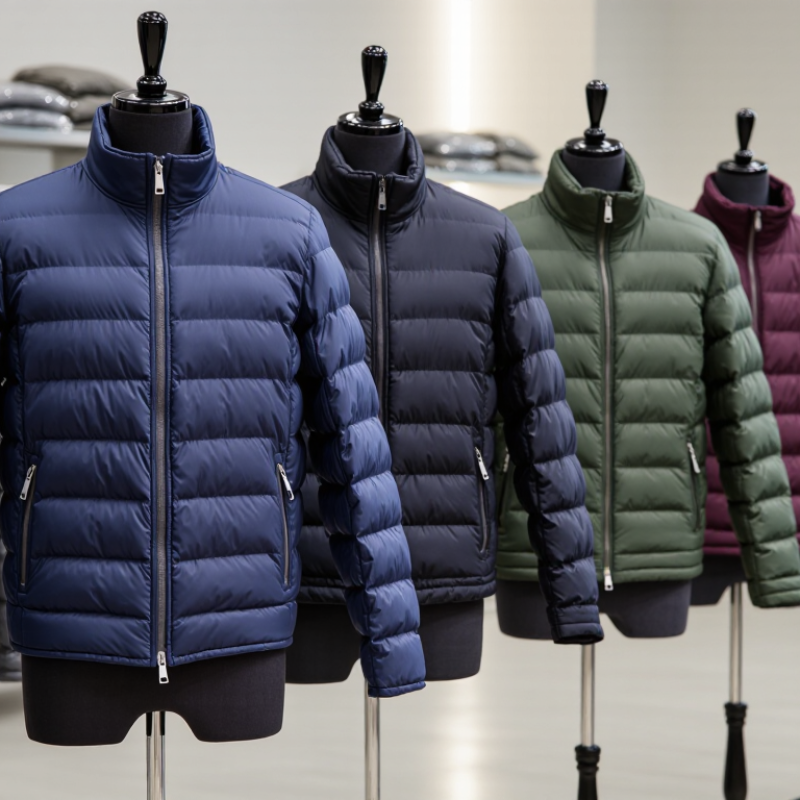
Reliable suppliers usually provide clear fabric specifications, size charts, insulation details, and production timelines. Recycled nylon or polyester shells can reduce weight while supporting everyday durability. Stitch spacing matters. Tight quilting helps keep insulation evenly distributed after washing. A practical sample check should include zipper movement, cuff recovery, pocket depth, and seam strength. Small faults often become expensive returns.

Experienced purchasing teams also review testing documents, factory capacity, packaging methods, and communication speed. Ask for pre-production samples before confirming large quantities. Color consistency can change between fabric batches, especially with dark green, navy, or charcoal shades. That detail is easy to overlook. Suppliers should explain inspection procedures and correction policies in writing. Forecasts remain imperfect, so flexible order quantities may protect buyers from excess inventory. A strong supplier is not simply the cheapest option; it is the one that combines stable quality, realistic lead times, and evidence-based production control.


Supplier Types: Compare OEM, ODM, and Private-Label Manufacturing Models

For global buyers sourcing men’s quilted jackets in 2026, the supplier model affects cost, control, and speed. OEM manufacturing follows your specifications, including fabric weight, quilting lines, insulation, pocket shape, labels, and packaging. It suits established buyers with technical files and reliable size charts. However, small measurement errors can create expensive rework. Confirm sample approval procedures before placing bulk orders.

ODM suppliers offer existing jacket designs that can be adjusted. You may change colors, shell fabrics, insulation levels, zippers, or logo placement. This route reduces development time and often lowers sampling costs. Ask for construction details, test reports, and recent production photos. A polished sample can still hide weak stitching or uneven quilting. Inspect the inside, not only the showroom surface.

Private-label manufacturing usually combines ready-made styles with your labels, hangtags, and packaging. It works well for retailers testing seasonal collections or smaller quantities. Confirm minimum order quantities, repeat-order terms, carton dimensions, and production capacity. Request a pre-production sample in the final fabric. I have found that clear inspection checkpoints prevent more problems than urgent price negotiations. Yet no model removes every risk. A cheaper quotation may exclude testing, packaging, or size corrections, so compare complete landed costs. Supplier communication matters too. Slow answers often become slower approvals.

Technical Standards: Assess Fill Power, GSM, DWR, and EN 13537 Testing

When evaluating men’s quilted jacket suppliers, technical data matters more than polished product photos. Fill power measures loft, usually in cubic inches per ounce. Higher fill power can provide better warmth with less weight. It does not guarantee a warmer jacket. Construction, fit, moisture, and wind protection also affect performance. Ask suppliers for test methods, sample conditions, and recent laboratory reports.

GSM shows the insulation weight per square metre. Compare GSM only within similar fill materials, because down and synthetic fibers behave differently. A 120 GSM synthetic layer may not equal 120 GSM down in warmth or compressibility. Request measurements from production samples, not only development samples. Small differences matter.

DWR should be checked through a recognized spray test, such as ISO 4920 or an equivalent method. Look for fabric-face results after washing, abrasion, and repeated wear. DWR is not waterproofing. It is only the first barrier.

Be careful with EN 13537 claims. This standard was created for sleeping-bag thermal ratings, not ordinary quilted jackets. A reliable supplier should explain whether the test applies to the garment, insulation panel, or another product. I have seen impressive certificates used without enough context. That is a warning sign. Ask for the tested configuration, ambient conditions, and pass criteria. A clear report is more valuable than a large number.

Sourcing Metrics: Benchmark MOQ, Lead Time, Capacity, and Landed Cost

Sourcing men’s quilted jackets requires more than comparing factory prices. McKinsey and The Business of Fashion forecast global fashion growth of only 2% to 4% in 2025. Buyers should protect cash flow. A practical benchmark is 300 to 800 pieces for initial orders, with 45 to 75 days for production. Larger programs may need 2,000 pieces or more. Always confirm whether the lead time includes fabric booking, quilting, inspection, and packing.

Capacity must be measured by monthly output, not factory claims. Request production records, quilting-machine counts, and recent delivery performance. Textile Exchange reported 124 million tonnes of global fiber production in 2023, with polyester representing about 57%. This matters because shell and padding availability can change costs quickly. UNCTAD reports that more than 80% of global merchandise trade by volume moves by sea. Freight, insurance, duties, packaging, and inland delivery belong in landed cost. A jacket quoted at 18 dollars may reach 24 dollars after these additions. Estimates can be wrong.

Tips: Ask for three landed-cost scenarios. Include normal, delayed, and small-volume orders. Require a size-set sample before confirming capacity. Check carton dimensions with your forwarder. A spreadsheet helps, but it is not proof. I would also leave a small contingency budget, because supplier promises rarely match every shipment.

2026 Best Men's Quilted Jacket Suppliers for Global Buyers

This non-brand-specific benchmark compares common supplier profiles for men's quilted jackets. Landed cost is an indicative USD estimate per jacket delivered to a major destination warehouse, excluding VAT and based on standard synthetic-shell specifications. Actual pricing depends on fabric, insulation, order volume, destination, duties, and compliance requirements.

Supplier Profile Benchmark MOQ Lead Time Estimated Annual Capacity Estimated Landed Cost
Mass-production supplier 5,000 units 60 days 1,200,000 units $24.80
Mid-scale compliant supplier 2,000 units 50 days 500,000 units $27.60
Flexible small-batch supplier 500 units 35 days 120,000 units $33.90

2026 Supplier Selection: Verify Audits, Certifications, and Compliance Data

For global buyers sourcing men’s quilted jackets in 2026, supplier selection should begin with verifiable compliance data. Request the latest social, quality, and environmental audit reports. Check the audit date, factory address, production scope, and unresolved findings. A certificate without a matching legal entity deserves closer review. Ask for the certificate number and confirm it through the issuing organization’s public records.

Walk through the factory virtually or in person. Inspect needle safety controls, fabric storage, fire exits, and worker training records. Request test reports for insulation, colorfastness, seam strength, and restricted substances. Reports should identify the exact jacket materials, testing laboratory, and sample date. Generic documents are weak evidence. I once accepted a neat-looking report too quickly; the listed factory had already changed. That mistake was avoidable.

Tips: Build a verification file for every supplier. Compare certificates against business licenses, audit findings, and shipment samples. Ask suppliers to explain each corrective action, not merely mark it closed. Recheck key documents before bulk production, because compliance status can change. Digital copies are useful, but signed records and independent confirmation are stronger. Allow time for unanswered questions. Speed can hide gaps.

2026 Best Mens Quilted Jacket Suppliers for Global Buyers - 2026 Supplier Selection: Verify Audits, Certifications, and Compliance Data

Supplier due-diligence data matrix for men's quilted jacket sourcing. Require current, independently verifiable evidence before approval.

Evaluation Category Verification Dimension Relevant Standard or Requirement Evidence to Request Minimum Acceptance Criterion Weight Review Status
Factory Audit Social and ethical working conditions ILO fundamental principles and applicable local labor law; buyer may use a recognized social-audit methodology. Latest independent social-audit report, corrective-action plan, worker-interview summary, and closure evidence for major findings. No unresolved critical findings; major findings have documented corrective actions and deadlines. 15% Verify
Factory Audit Health, safety, and emergency preparedness Applicable occupational health and safety law; ISO 45001 may be used as a structured management-system reference. Occupational-safety audit, fire-inspection records, evacuation drills, emergency plans, equipment-maintenance logs, and training records. Valid fire-safety documentation; unobstructed exits; documented drills and corrective-action closure. 10% Verify
Certifications Quality management system ISO 9001:2015 certification, where claimed, issued by a competent certification body. Certificate number, scope, validity dates, issuing certification body, and certificate verification record. Certificate is current, scope covers garment manufacturing, and details match the legal manufacturing entity. 10% Verify
Product Safety Restricted substances in textiles and trims Destination-market chemical requirements, including applicable REACH restrictions for the European Union and buyer-specific RSL limits. Recent laboratory test reports for shell fabric, lining, padding, dyes, prints, coatings, buttons, zippers, and other trims. All tested materials comply with the buyer's RSL and the legal requirements of the target market. 15% Verify
Product Safety Flammability and labeling Applicable textile flammability, fiber-content, care-labeling, country-of-origin, and product-labeling rules in the destination market. Pre-production and final-product test reports, approved artwork, care-label specification, fiber-content declaration, and packaging information. Labels and test results match the finished product and destination-market requirements. 10% Verify
Traceability Material and production traceability Documented chain of custody from fabric, filling, and trims to finished-goods shipment; recycled-content claims require appropriate evidence. Approved supplier list, purchase records, lot numbers, production records, packing lists, and traceability test or transaction records where applicable. At least one finished-goods lot can be traced back to key material sources and production dates. 10% Verify
Environmental Environmental management and permits Applicable wastewater, air-emission, waste-disposal, and chemical-storage laws; ISO 14001 may support environmental-system verification. Environmental permits, waste-transfer records, wastewater or emissions test results, chemical inventory, and environmental-audit report. Required permits are valid; hazardous waste is handled by authorized parties; no unresolved serious violation. 10% Verify
Responsible Sourcing Forced-labor and human-trafficking controls Applicable forced-labor laws in the import market, including supply-chain due-diligence obligations where relevant. Supplier code of conduct, forced-labor risk assessment, recruitment-fee policy, worker contracts, grievance records, and upstream due-diligence process. Written prohibition exists; workers do not pay recruitment fees; risks are assessed beyond the final assembly site. 10% Verify
Capacity Production capability for quilted jackets Documented capability for cutting, quilting, padding insertion, sewing, pressing, inspection, packing, and seasonal production planning. Machine list, line layout, monthly capacity by product type, sample room details, staffing plan, and production lead-time history. Capacity is supported by physical equipment, trained personnel, and documented production records. 10% Verify
Quality Control Inspection and defect prevention Written quality plan using agreed specifications, measurement tolerances, workmanship standards, and sampling procedures. Quality manual, inspection checkpoints, measurement report, defect classification, needle-control procedure, and final-inspection records. Pre-production, in-line, and final inspections are documented; critical defects trigger documented containment. 10% Verify
Commercial Compliance Legal identity and export documentation Supplier legal registration, manufacturing-site identity, tax or customs registration where applicable, and accurate shipping documentation. Business registration, factory address, bank-account ownership evidence, export records, commercial invoice sample, and packing-list sample. Legal entity, factory location, contracting party, and payment beneficiary are consistent and verifiable. 5% Verify
Data Integrity Audit and certificate authenticity Independent confirmation through the issuing certification body, laboratory, audit provider, or official public verification system. Original PDF documents, verification links, report reference numbers, laboratory accreditation details, and document issue dates. No altered, expired, unverifiable, or entity-mismatched documents; discrepancies are resolved before approval. 5% Verify

Assessment rule: Approve a supplier only after document verification, factory or third-party audit review, product testing, and corrective-action closure. Standards and legal requirements must be checked against the destination market because requirements may differ by country and product configuration. Reference frameworks: ILO Labour Standards, ISO 9001, ISO 14001, ISO 45001, EU REACH Regulation.