



The T-Shirt Yarn Revolution: A Comprehensive Home DIY Guide
Have you ever considered transforming your old t-shirts into a sustainable crafting material? With a few simple steps, you can create homemade yarn that breathes new life into discardeD Clothing. DIY t-shirt yarn isn’t just an eco-friendly craft—it’s a gateway to zero-waste creativity. This professional guide breaks down the process with technical precision, suitable for both crafting novices and experienced makers.
Core Crafting Principles
- Material Recycling: Transforms 100% cotton t-shirts into reusable crafting yarn
- Accessible Technique: Step-by-step protocols with built-in error tolerance
- Scientific Material Selection: Specialized processing for cotton knit fabrics
- Versatile Applications: Ideal for weaving rugs, crocheting bags, and other textile projects
- Cost Efficiency: Utilizes household tools for professional-grade results
Materials & Tools Specification
Premium Material Guide
| Material Type | Selection Criteria | Avoidance Notes | Functional Role |
| 100% Cotton Knit | Solid-color, minimal damage | Lycra/spandex blends | Ensures uniform curling |
| Industrial Scissors | 15cm+ sharp blades | Dull household shears | Creates clean, fray-free cuts |
| Cutting Accessories | Self-healing rubber mat | Direct cutting on glass/wood | Protects work surfaces |
|
| 60mm rotary cutter | Stationery-grade cutters | Enhances continuous cutting |
Pre-Processing Protocols
Three-Stage Fabric Preparation
- Physical Smoothing
- Lay t-shirt flat on cutting mat; iron at low temperature (≤110℃) to remove wrinkles, focusing on natural curls around armpit seams.
- Structural Dismantling
- Hem Removal: Cut 5mm above bottom seam to eliminate reinforced edging
- Upper Section Trimming: Horizontal cut 2cm below armpit points to retain tubular fabric body
- Processing Comparison Chart
| Operation | Common Mistakes | Standard Result | Error Tolerance |
| Fabric Smoothing | 3mm+ wrinkles present | ≤1mm flatness | ≤2mm wrinkles acceptable |
| Edge Cutting | Cuts deviate >5° from straight | ≤3° linear accuracy | Single deviations ≤1cm repairable |
Spiral Cutting Technology
Strip Dimensioning
- Optimal Width Ratio: 1.2 inches (3cm) as baseline, ±0.2-inch tolerance
- Marking Technique: Use water-soluble fabric pens along grain lines, with 10cm alignment reference points.
Advanced Cutting Methods
- Spiral Initiation
- Begin 1.5cm from edge of tubular fabric, cut at 45° angle to opposite edge
- Rotate fabric 180° after each full circle to maintain cutting consistency
- Continuous Cutting Essentials
- Maintain 10cm/second cutting speed to avoid wavy edges
- 5cm width deviations can be corrected via post-stretching
- Efficiency Metrics
| Traditional Cutting | Spiral Cutting | Productivity Gain | Yarn Continuity |
| Segmented strips | Uninterrupted spiral | 400% faster | No joint points |
| Avg. length 5m | Avg. length 25m | 500% longer | <5% material waste |
Yarn Post-Processing
Physical Modification
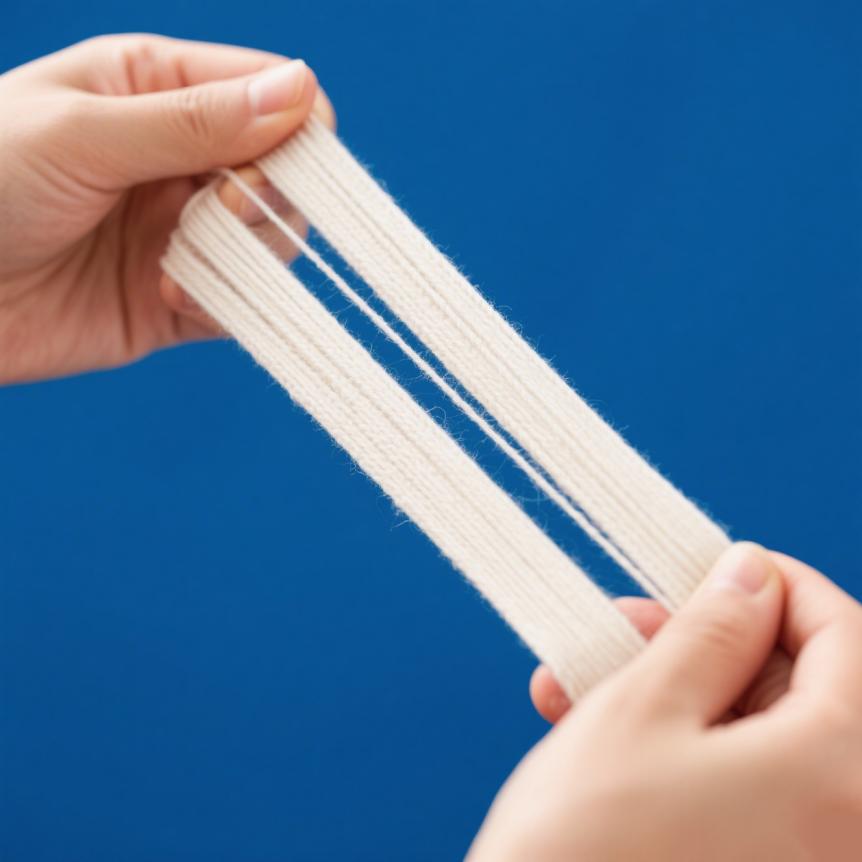
- Bi-Directional Stretching
- Grasp yarn ends, apply 1.5kg constant tension, stretch uniformly along length
- Hold at 130% original length for 10 seconds to induce natural curling
- Curling Optimization Tips
- Ideal humidity: 60%±5% RH for optimal texture formation
- Temperature control: 25℃±2℃ to prevent fiber brittleness
- Performance Enhancement Data
| Pre-Processing | Post-Processing | Tensile Strength | Curl Density | Craft Suitability |
| Loose strips | Spiral yarn | +280% stronger | 3 coils/10cm | Crocheting |
| 1.2N breaking strength | 3.4N | +283% improvement | 400% more abrasion resistance | Weaving |
Creative Applications
Project Tier System
- Beginner: Coaster weaving (requires 5m yarn + 6/0 crochet hook)
- Intermediate: Throw pillow cover (20m yarn + sewing machine)
- Advanced: Area rug hooking (100m yarn + specialized latch hook)
Environmental Impact Analysis
- Each L-size t-shirt yields ~30m yarn, reducing textile waste by 0.2kg
- 75% lower material cost compared to purchasing commercial yarn
- Chemical-free process compliant with OEKO-TEX® standards
Technical Summary & Expansion
From material selection to yarn formation, precision in each step dictates final quality. Note that cotton’s natural elasticity is critical for curl formation, while cutting angle accuracy directly affects yarn continuity. For first-time attempts, light-colored t-shirts are recommended to better visualize cutting trajectories.
As proficiency grows, explore advanced techniques like color-blocking (combining different t-shirts) or texture manipulation (retaining selective fraying). Every ball of homemade t-shirt yarn represents more than a crafting material—it’s a tangible expression of sustainable living. Let’s reimagine waste as creative potential, stitch by stitch building a zero-waste aesthetic.
Professional Tips: For industrial-scale results, pre-wash t-shirts in cold water to stabilize fibers. Store finished yarn in breathable cotton bags to maintain curl integrity.